MSME Brand Infrastructure: Structuring Positioning Before Copywriting
The brand workflow separates positioning logic from copy generation. MSME inputs become a structured strategy object first, then a buyer-facing memo, with streaming output, cached recovery, and inspectable strategic logic.
Brand Form
FastAPI Endpoint
Strategy JSON
JSON Cleanup
Memo Stream
Logic View
The first version of the brand workflow had a familiar problem.
If the model jumped straight into copywriting, it produced better words around the same weak positioning.
That was not enough.
The context was a local MSME trying to look more credible for bigger, more formal buyers. That is common here. A small business may already have a good product, reliable supply, and enough operating discipline to handle bulk orders, but the public-facing material still sounds informal.
The product description is scattered.
The buyer promise is vague.
The tone changes depending on who wrote the message.
The business can serve bigger clients, but the brand surface does not make that obvious.
That becomes a real commercial problem when the buyer is a hotel, school, clinic, distributor, procurement office, or corporate team. They are not just checking if the product exists. They are checking if the supplier looks organized enough to trust with volume.
A tagline generator does not solve that.
The workflow needed to separate strategy from copy.
Phase 1: define the positioning logic
Phase 2: write the brand memorandum
That was the main architecture decision.
The workflow starts with plain MSME inputs
The frontend starts with four inputs:
company name
business description
target audience
tone
Those inputs are simple on purpose. For an MSME, the system should not require a brand strategist’s vocabulary before it becomes useful. The owner or sales lead should be able to describe what they sell, who they sell to, and how formal the output should sound.
The request flow looks like this:
brand form
→ FastAPI brand endpoint
→ AI gateway
→ Phase 1 strategy JSON
→ JSON cleanup
→ Phase 2 memo generation
→ SSE stream
→ strategic memo view
→ strategic logic view
The system builds positioning logic first, then uses that structured strategy to generate the final buyer-facing memorandum.
Phase 1 creates the positioning layer
The first model call does not write the final memo.
It returns a structured strategy object:
red_ocean_competitors
blue_ocean_opportunity
market_precedent
primary_archetype
secondary_archetype
brand_enemy
strategic_direction
confidence_score
That object becomes the internal positioning layer.
The naming in the code is a little aggressive because this was built as a demo engine, but the shape is useful. Before the app writes anything polished, it first identifies the generic patterns the business should avoid, the wedge it should emphasize, the buyer belief it needs to challenge, and the strategic direction the copy should follow.
That prevents the second phase from becoming generic marketing output.
A weaker version would do this:
business description
→ LLM
→ brand copy
This version adds a control layer:
business description
→ structured positioning object
→ memo generation from that object
That is the useful part.
The backend also has a JSON cleanup step. If the model wraps the strategy object in a markdown code block, the service strips it before parsing. If parsing fails, the backend returns a fallback strategy instead of crashing the workflow.
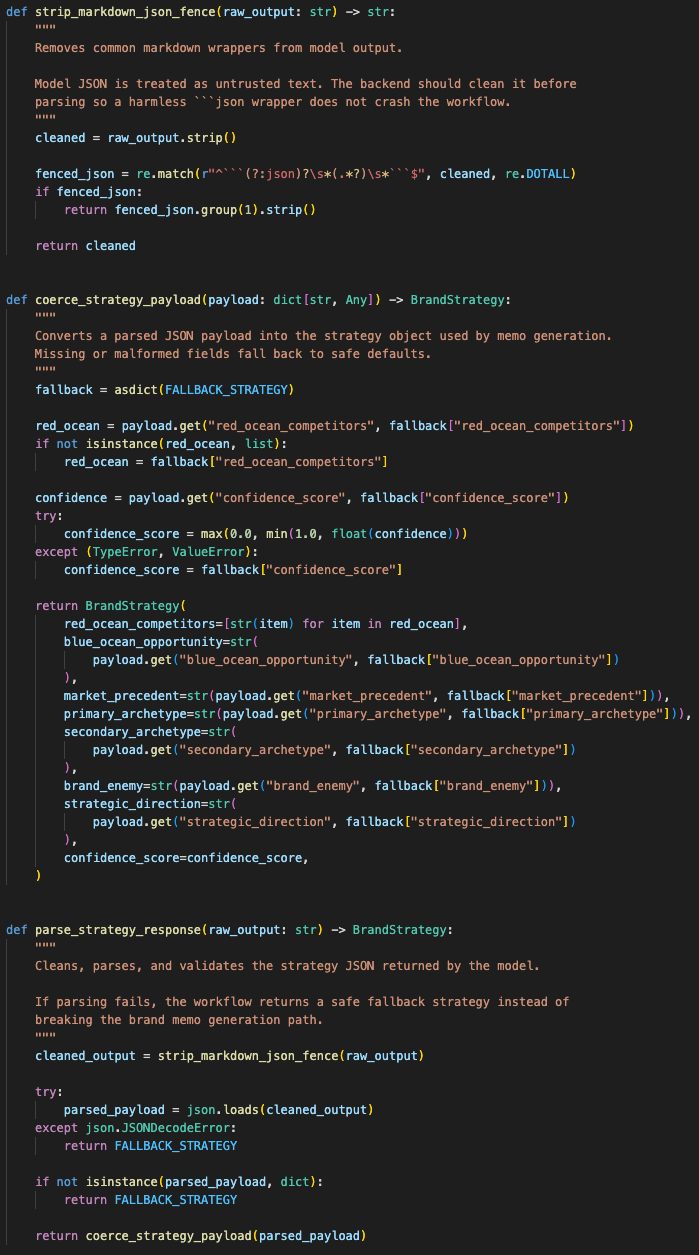
The backend treats model JSON as untrusted output and cleans, parses, or falls back instead of crashing the brand workflow.
Phase 2 writes from strategy, not from a blank prompt
The second phase uses the strategy object as source material.
The memo generator receives the strategic brief, target tone, and a strict section structure:
- Executive Summary
- Strategic Wedge & Precedent
- Verbal Identity Framework
- Messaging Architecture
The output is not just a tagline list. It is a strategic position memo that can be printed, shared internally, or used as source material for a website, sales deck, product sheet, or proposal.
That matters for small businesses trying to sell upward.
A formal buyer does not need cute copy. They need clarity:
- What the business does
- Who it serves
- Why it is different
- What language to use
- What language to avoid
- What promise should anchor the offer
The voice guideline section is especially useful.
The app asks the model to produce a table of “Do This” and “Don’t Do This” examples. The frontend catches that table and renders it as a two-column visual grid.
That turns abstract brand advice into operating guidance.
say this
avoid this
For an MSME, that is practical. It helps the owner, admin, salesperson, or designer avoid rewriting the brand from scratch every time they prepare a caption, product sheet, quotation, or buyer message.
The logic view keeps the strategy inspectable
The frontend also exposes a separate logic view.
The memo tab is the polished output. The logic tab shows the underlying strategy fields:
red ocean trap
blue ocean wedge
market precedent
brand enemy
primary archetype
secondary archetype
confidence score
The user can inspect the positioning logic behind the memo instead of trusting a single polished generated output.
That separation is important.
The user should be able to inspect the positioning logic before trusting the final memo. If the wedge is wrong, they should adjust the business description or target audience. If the target buyer is too broad, they can tighten the audience field. If the tone is too premium, too friendly, or too technical, they can regenerate with a different voice protocol.
A single chat output would hide that.
Streaming makes the workflow feel controlled
The streaming path also matters for the user experience.
The backend exposes a streaming route. The frontend reads the SSE response, watches for status changes, stores the strategy object when Phase 1 finishes, then starts rendering the memo as chunks arrive.
The frontend does not dump raw chunks straight into the page. It uses a network buffer, a display buffer, and requestAnimationFrame to smooth the output.
network stream
→ network buffer
→ display buffer
→ smooth memo rendering
That is overkill for a basic form, but useful for a live demo. It makes the system feel controlled instead of twitchy.
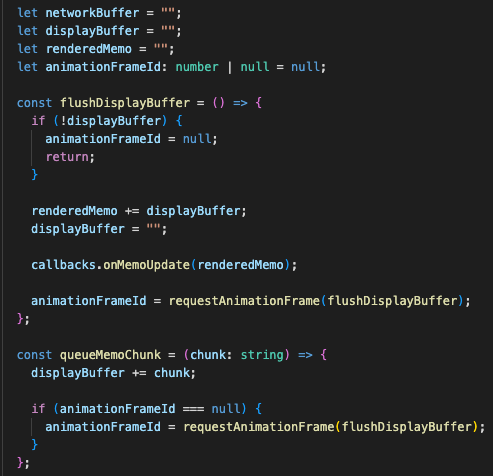
The frontend separates network chunks from display updates so the generated memo renders steadily during a live demo.
Session caching protects demo recovery
The app also caches completed results in sessionStorage.
That was built for demo reliability. If the page refreshes during a live walkthrough, the app can replay the generated memo instead of forcing another provider call.
same input hash
→ sessionStorage cache hit
→ replay result
→ avoid duplicate generation
For portfolio demos and client walkthroughs, that matters. AI systems fail in embarrassing ways when every reload means another live call. Caching gives the demo a recovery path.
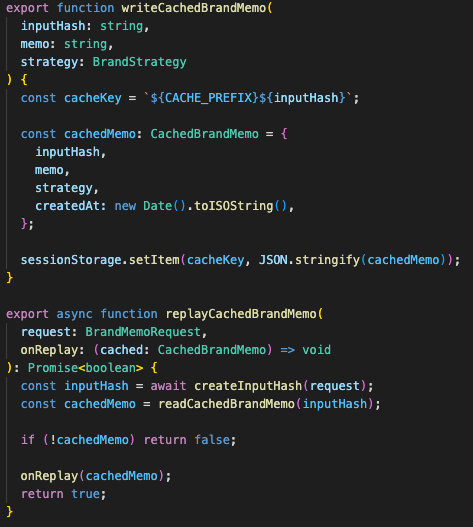
Completed results can be replayed after a refresh instead of forcing another provider call during a walkthrough.
The AI gateway keeps creative work behind backend controls
The AI gateway sits behind the endpoint, the same pattern as the other engines.
The frontend does not talk directly to the provider. The backend owns:
- API key handling
- Model routing
- Budget cap
- Redis spend tracking
- Redis rate limiting
- Provider retries
- Exponential backoff
- Token usage tracking
That gives the brand app the same operational boundary as the proposal and verification engines. The brand workflow may feel more creative, but it still sits behind backend controls.
That is the difference between an AI toy and a serviceable workflow.
The MSME business case is specific
For the Philippine MSME context, the business case is straightforward.
Many small suppliers do not need a “brand transformation.” They need a clearer way to present themselves when a bigger buyer asks:
- Who are you?
- What do you supply?
- Why should we trust you?
- Can you handle volume?
- What makes you different from cheaper alternatives?
The system helps turn loose business descriptions into a more formal buyer-facing structure.
That does not replace real market research. It does not verify demand. It does not prove the business can fulfill bulk orders. Those are separate operational questions.
The safe claim is narrower:
This turns informal business context into structured positioning and reusable brand messaging.
That is still valuable.
The next step is sales-asset generation
The next production step would be connecting the brand strategy to real sales artifacts.
brand strategy
→ product sheet
→ quotation intro
→ corporate buyer email
→ supplier profile
→ proposal cover page
→ website hero section
For MSMEs, that is where this becomes more useful. The strategy memo should not sit alone. It should become source material for the documents they actually send when chasing bigger clients or bulk orders.
The stronger version would also add deterministic checks:
buyer type
→ required trust signals
→ missing collateral checklist
→ brand strategy
→ generated sales assets
→ human approval
For example, a supplier targeting hotels may need different trust signals from a supplier targeting schools. A food business may need permits, delivery capacity, packaging details, and consistency claims. A service business may need process, turnaround time, contact structure, and sample work.
The app does not have that domain logic yet, but the service boundary is ready for it.
Strategy before copywriting
For now, the prototype establishes the first control layer: strategy before copywriting, structured reasoning before memo generation, streaming output, cached demo recovery, and a separate logic view so the user can inspect the positioning before using the final language.
That is already a better pattern than asking AI for “a better brand.”
A business trying to sell to bigger buyers does not need prettier adjectives first. It needs clearer positioning, consistent language, and a formal enough surface to be taken seriously.
The copy comes after that.
Onto the next one. Let’s keep sharpening that edge!
First written on July 24, 2025.
Want to implement this architecture in your business?
Discuss Your Project